
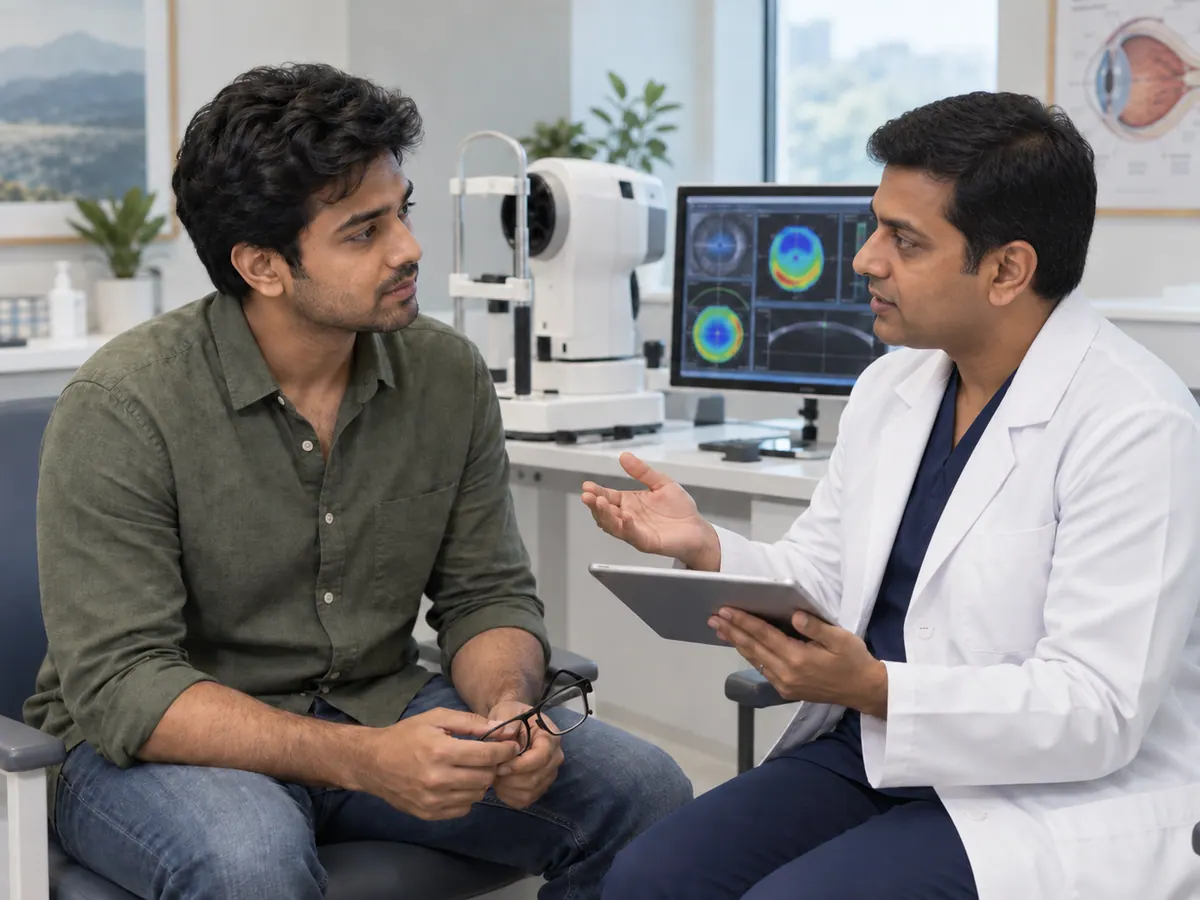
Suitability is more than spectacle power
Assessment considers prescription stability, corneal shape and thickness, tear film, pupil size, retina, medicines, medical conditions, pregnancy, occupation and expectations.
Some people are better suited to another procedure or to continued spectacles. A responsible consultation can conclude that laser correction is not advisable.
What LASIK changes
LASIK reshapes the cornea to alter focusing power. It may reduce distance-glasses dependence, but no ethical plan guarantees 20/20 vision or permanent freedom from spectacles.
Near focusing changes with age, so reading glasses may still be needed later. Corneal laser treatment does not treat retinal or optic-nerve disease.
After the procedure
Arrange transport, use medication as directed and avoid rubbing, eye makeup, swimming and dusty environments until cleared. Early watering, light sensitivity, blur or fluctuation may occur.
Keep scheduled reviews and report new or worsening symptoms rather than restarting an old drop.
Who may not be an ideal LASIK candidate?
A stable spectacle prescription is only one requirement. Thin or irregular corneas, keratoconus risk, significant dry eye, uncontrolled autoimmune disease, certain medicines, pregnancy-related power change and unrealistic expectations can make LASIK unsuitable. Very high prescriptions may leave too little safe corneal tissue or reduce the quality of night vision.
Suitability testing commonly includes refraction, corneal topography or tomography, pachymetry, tear-film assessment and a dilated retinal examination. Contact lenses can temporarily alter corneal measurements, so patients may be asked to stop wearing them before testing. If LASIK is not advised, surface laser, an implantable lens or ordinary spectacles may be safer alternatives.
Understanding recovery and long-term expectations
Vision often improves quickly, but sharpness, dryness, glare and halos can fluctuate during early healing. Screen work may be possible before night driving feels comfortable. Follow the prescribed drop schedule and protection advice, attend reviews and avoid rubbing because the corneal flap or healing surface requires care even when vision seems good.
Laser vision correction does not freeze the eye at one age. Natural prescription change, presbyopia and cataract can occur later. Enhancement is not always possible or necessary. A sound LASIK decision balances convenience against corneal safety, night-vision needs, occupation and acceptance that glasses may still be useful for some tasks.
Questions to ask before laser vision correction
Ask which procedure is being recommended, why it suits your cornea and what alternatives remain. Request realistic estimates for residual power, dry-eye symptoms, glare, night driving and future reading glasses. People in defence, aviation, transport or contact sports should check occupational rules before surgery. Price comparisons are incomplete unless they include preoperative testing, surgeon review, medicines, follow-up and the policy for managing complications or considering enhancement.
Questions patients commonly ask
What is the best age for LASIK?+
There is no single best age. The prescription should be stable and the eyes healthy. Age also affects future reading-glass needs, so suitability is determined by examination rather than birthday alone.
Can LASIK permanently remove glasses?+
LASIK can reduce dependence on glasses, but no ethical provider can promise permanent freedom from them. Prescription change, presbyopia and cataract may create new visual needs later.
Does LASIK hurt?+
Anaesthetic drops limit pain during treatment. Pressure or discomfort may be felt, and surface irritation or watering can occur afterward. Severe or increasing pain requires urgent review.
Clinical references
This guide is informed by patient guidance from established public-health and professional medical bodies.