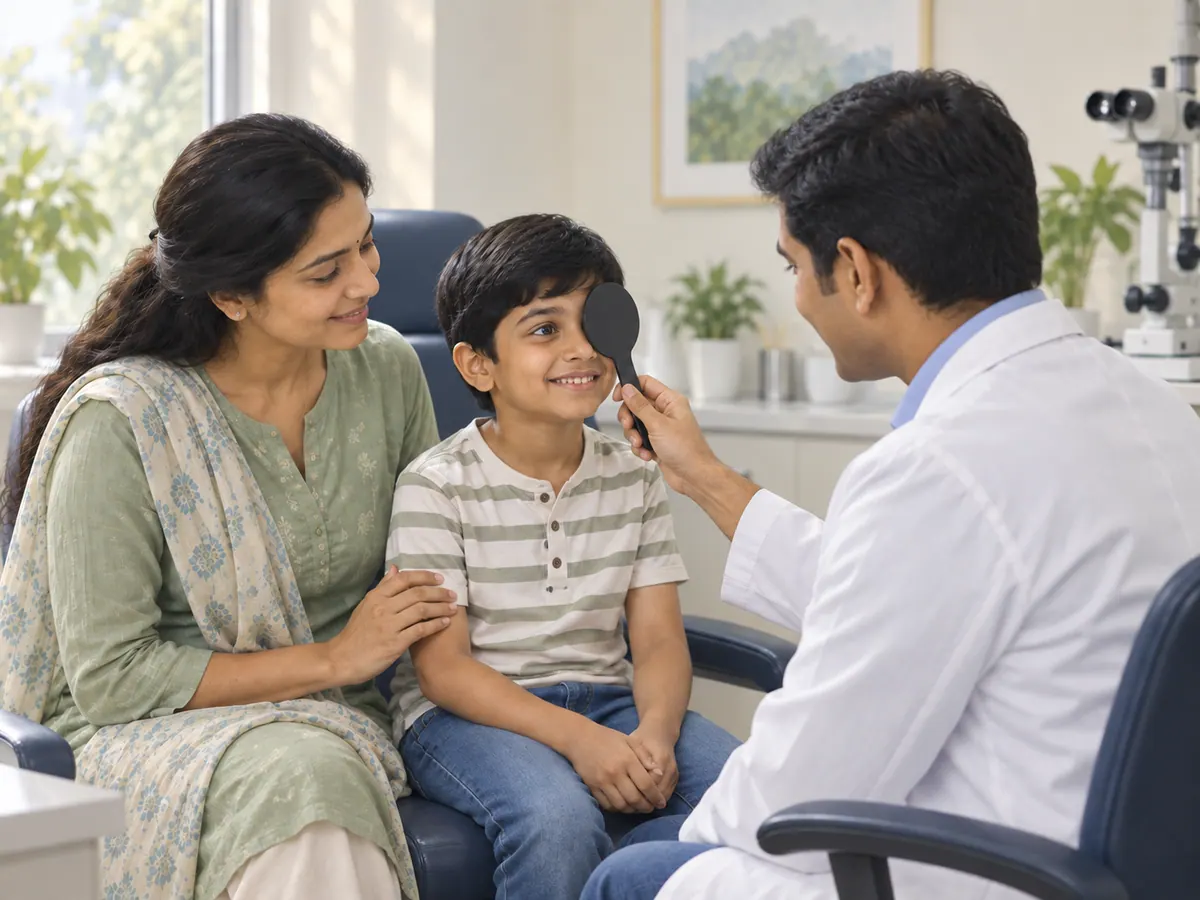
Children's eye conditions
The same behaviour can come from very different visual problems.
Squinting, sitting close or avoiding reading does not establish a diagnosis. Testing each eye separately and examining focusing, alignment and eye health helps distinguish refractive blur, amblyopia, eye disease and non-visual causes.
01Myopia, hyperopia and astigmatism
Refractive errors
A child may not know that the board, books or one eye looks blurred. Unequal prescriptions can be especially difficult to notice because the stronger eye compensates.
How care may be plannedAge-appropriate vision testing and cycloplegic refraction help determine whether glasses are needed. Prescriptions are reviewed as the eyes grow, with closer follow-up when vision differs between the eyes.
02Reduced visual development
Amblyopia
Amblyopia develops when the brain receives a consistently blurred or conflicting image from one or both eyes during childhood. The eye may look completely normal, and children rarely identify the weaker eye themselves.
How care may be plannedTreatment begins with the cause—often glasses, alignment care or cataract management—then may include prescribed patching or atropine in the better-seeing eye. Earlier treatment is generally more effective, but older children may still benefit after assessment.
03Eyes that do not align together
Strabismus (squint)
One eye may turn inward, outward, upward or downward constantly or intermittently. Squint can affect binocular vision, depth perception and visual development, although not every apparent eye turn is true strabismus.
How care may be plannedThe plan depends on age, vision, refractive error and the type and frequency of the deviation. Glasses, amblyopia treatment, prisms or eye-muscle surgery may be considered for selected children.
04Clouding of a developing eye’s lens
Childhood cataract
A cataract present at birth or developing in childhood can block a clear image from reaching the retina. Dense central cataracts can rapidly interfere with visual development, while small peripheral cataracts may only need monitoring.
How care may be plannedVisually significant cataracts require prompt specialist planning. Surgery may be followed by an intraocular lens, contact lens or glasses plus sustained amblyopia treatment and long-term monitoring.
05Increasing short-sightedness
Progressive childhood myopia
Myopia makes distant objects blurred and often increases while the eye is growing. Higher myopia is associated with greater lifetime risk of retinal and other eye complications.
How care may be plannedAccurate glasses remain essential. Outdoor time and, for suitable children, evidence-based myopia-control options such as specialised lenses or low-dose atropine can be discussed with benefits, limitations and follow-up requirements.
06Persistent watering or discharge in infancy
Blocked tear duct
A congenital nasolacrimal duct obstruction prevents tears draining normally and can cause overflow, crusting or discharge. Most resolve during the first year, but persistent watering also needs assessment for less common causes.
How care may be plannedParents may be taught the correct massage technique. Antibiotic drops treat significant discharge rather than opening the duct. Persistent or severe obstruction may require probing or another drainage procedure.
07ROP screening for premature infants
Retinopathy of prematurity
ROP affects developing retinal blood vessels in babies born very prematurely or at very low birth weight. Early stages are invisible to parents, so screening must follow the neonatal team’s timetable.
How care may be plannedMany babies require observation only; higher-risk disease may need laser, anti-VEGF treatment or surgery through an appropriately trained retina team. Follow-up dates must be kept precisely.
08Difficulty distinguishing certain colours
Colour vision deficiency
Inherited red–green colour vision deficiency is more common in boys and may only become apparent during school tasks. It does not usually reduce sharpness of vision.
How care may be plannedTesting can document the pattern and support practical classroom and career counselling. No spectacle or exercise restores inherited colour discrimination, but clear labelling and alternative cues can help.
09Droopy lid, white pupil or unusual eye appearance
Ptosis and other visible eye differences
A droopy lid can block vision or induce astigmatism. A white pupil, abnormal red reflex, enlarged eye or persistent asymmetry may signal a condition requiring urgent investigation.
How care may be plannedExamination determines whether the difference threatens sight, indicates another eye disorder or is primarily cosmetic. Timing of treatment is based on visual development and the underlying cause.